A word search has one of the shortest setup times of any paper activity: choose a word, find its first letter, follow the sequence, and circle it. That simplicity is exactly why it works well in a travel bag, classroom, restaurant, or quiet corner at home.
The puzzle also gives children a reason to look closely at spelling. To find PLANET, a solver has to keep the letters in order, check direction, and reject near-matches such as PLANE. That is useful language practice, but it still feels like a hunt rather than a worksheet.
This guide explains how to choose a suitable word search for kids, teach a repeatable scanning method, and give hints without doing the satisfying part for them.
TIP
Try two colors: Use one color to underline a word in the list and a matching color to mark it in the grid. Switching colors every few words makes solved entries easy to check and keeps a busy page organized.
What children practice while solving
Word searches are not a replacement for reading stories, phonics instruction, or spelling practice. They are a light, enjoyable way to use some of the same underlying habits:
- Letter-order awareness: The letters must appear in the right sequence, even when the word runs vertically, diagonally, or backward.
- Visual scanning: Solvers compare many letters while trying to move through a grid systematically.
- Spelling recall: A child may hold a short word or letter chunk in mind while checking possible paths.
- Vocabulary review: Themed lists bring related words together, especially when paired with facts or discussion.
- Persistence: A clearly defined list makes progress visible, one circled word at a time.
The strongest benefit is often practical: the child chooses a strategy, tests it, notices a mismatch, and tries again. No timer is required, and a half-finished page can wait until later.
Teach this five-step scanning method
Randomly staring at the whole grid works occasionally, but it becomes frustrating as puzzles grow. A simple process gives young solvers somewhere to begin.
- Choose one target word. Start with a word the child recognizes and can say aloud.
- Mark the first two letters. For TIGER, look for TI, not every T. The pair eliminates many false starts.
- Pick one direction at a time. Check left to right first, then top to bottom. Add diagonals and backward words only when the puzzle uses them.
- Trace before circling. Slide a finger or pencil lightly across all the letters to confirm the complete word.
- Cross it off the list. This shows progress and prevents searching for the same word twice.
Model the method once, then let the child choose the next word. The goal is to hand over the strategy, not race them to every answer.
NOTE
If the grid feels visually crowded, cover part of the page with a blank sheet. Reveal four or five rows at a time, or cut a viewing window in an index card. This changes the amount on view without changing the puzzle itself.
Choose challenge by puzzle design, not age alone
Two grids of the same size can feel completely different. Word length, font size, directions, repeated letter patterns, and a child's familiarity with the theme all matter. Use age ranges only as rough starting points.
| Starting stage | Grid and word features | Directions to try | A good sign to move on |
|---|---|---|---|
| New solver | Large letters, short familiar words, generous spacing | Left to right | Finds several words independently and understands how to cross them off |
| Building confidence | Small or medium grid, a mix of short and longer words | Horizontal and vertical | Checks full spellings instead of circling look-alike chunks |
| Ready for variety | Medium grid, themed vocabulary, more repeated letters | Add diagonals | Uses a scanning plan and can recover from false starts |
| Experienced solver | Larger grid, longer or less familiar words | Add backward words and all directions | Enjoys the challenge without needing frequent rescue hints |
A good puzzle should contain early wins and a few words that require patience. If nearly every word needs adult help, step down in complexity or solve as a team.
Make spelling visible
The word list is not just a checklist. It can become a quick language activity without making the session feel like schoolwork.
Before searching, ask the child to notice one feature:
- the first two letters in ASTRONAUT;
- the smaller word star inside STARFISH;
- the repeated letter in RABBIT;
- or the ending shared by COMET and another word on the page.
For longer targets, cover the grid and clap or tap the syllables first. Then uncover the puzzle and search for a recognizable chunk. A child who cannot yet read every listed word can still match letter sequences with help pronouncing the word.
Keep this playful. One spelling observation per puzzle is plenty. The main activity should remain finding words.
How to help without taking over
Adults spot answers quickly, which can make “helping” surprisingly difficult. Use a hint ladder and pause after each step:
- Direction hint: “This one goes down.”
- Area hint: “Try the right half of the grid.”
- Row or column hint: “Its first letter is in this row.”
- Starting-letter hint: Point to the correct first letter and let the child test the path.
Avoid tracing the complete answer unless the child asks to finish together. Finding the last two or three letters independently preserves the small moment of discovery.
If frustration is building, switch roles. Let the child read the list while the adult searches, or ask the child to verify whether an adult's deliberately chosen path is correct. Another option is to find one easy word together and stop for the day.
Theme turns vocabulary into conversation
A themed puzzle gives families something to talk about beyond the grid. Animal words can be sorted by habitat, movement, diet, or body covering. Space words can be grouped into objects, people, equipment, and actions.
Try one short follow-up after a puzzle:
- Choose three animal words and invent a habitat that could include all of them.
- Sort the found words into “on Earth” and “in space.”
- Pick the strangest or newest word and look up what it means together.
- Draw a tiny scene containing five words from the completed list.
- Use three found words in a silly sentence or mini-story.
The included facts in a themed book can supply the conversation starter. There is no need to quiz a child afterward; curiosity is enough.
Easy routines that actually fit the day
Word searches are most useful when the routine is small enough to repeat.
- After-school reset: Put out one puzzle with a snack and no expectation that it must be finished.
- Travel kit: Keep a book, two pencils, a sharpener, and a flat clipboard in a zip pouch.
- Waiting-time activity: Choose a target such as “find five words” instead of committing to the whole page.
- Sibling or parent pair: Take turns choosing the target word, or assign one person horizontal words and the other vertical words.
- Weekly theme: Pair one puzzle with a library book, documentary, drawing prompt, or family conversation about the same topic.
Ten pleasant minutes are more valuable than pushing through a page after the child has lost interest.
Animal or space: which book should you choose?
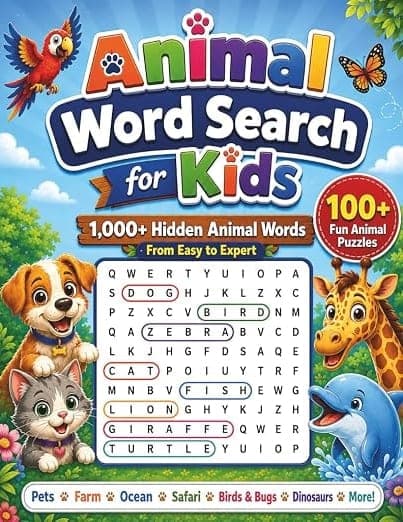
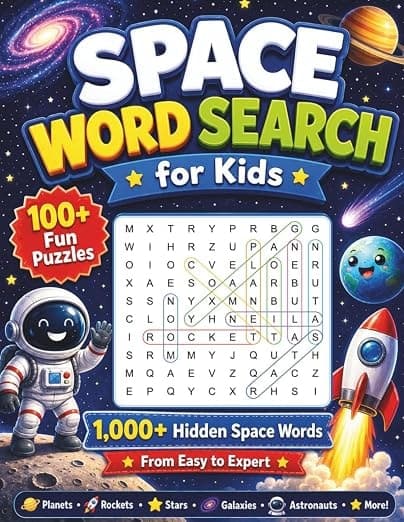
Both books in the Word Search for Kids series use a progressive Easy-to-Expert structure, 100+ puzzles, a large 8.5 × 11-inch page, and complete solutions. The theme is the main decision.
| Book | Choose it for a child who… | Included content |
|---|---|---|
| Animal Word Search for Kids | Talks about pets, wildlife, oceans, farms, or dinosaurs | 1,000+ hidden words and animal facts across themed puzzles |
| Space Word Search for Kids | Loves planets, astronauts, rockets, and big questions about the universe | 1,000+ hidden space words, facts, and space doodles |
The progressive structure means a child can begin with more approachable puzzles and work toward all-direction challenges rather than meeting the hardest grid on page one.
Start a word-search adventure
Animal Word Search for Kids contains 100+ puzzles, 1,000+ hidden words, animal facts, and complete solutions in a 120-page paperback. Buy the Animal edition on Amazon.
Space Word Search for Kids contains 100+ puzzles, 1,000+ hidden space words, facts, doodles, and complete solutions in a 119-page paperback. Buy the Space edition on Amazon.
You can also browse the full Word Search for Kids series or download free printable puzzles for an easy place to begin. Pick one word, scan in one direction, and let the first find create the momentum for the rest.